









At Joosse Family Orthodontics in Williamsburg, VA, we often talk with families about habits that influence how a child’s smile develops. One topic that continues to come up is thumb sucking. While many people use the term “thumb sucking,” it actually refers to a variety of finger habits, including sucking on other fingers or combinations of fingers. But, in my world right now: it’s thumb sucking.
Lately, this topic has been on my mind for a few reasons. I recently completed palate expansion for my own daughter (the subject of a previous blog post), and I also have two patients currently in braces who had finger habits that continued into their preteen years. These experiences have been a reminder that even when a habit stops, the effects sometimes continue to influence a child’s developing smile.
How Thumb Sucking Affects Jaw Development
When children suck their thumbs or fingers, the habit affects the way the upper jaw develops. The tongue normally rests against the roof of the mouth and provides natural pressure that helps guide the growth of the upper jaw. When a thumb or finger replaces that position, the tongue is no longer providing the same support during development and the jaw is often under-developed in the transverse (side to side) dimension.
At the same time, thumb sucking creates negative pressure inside the mouth. The cheeks push inward with increased force, which may limit the normal side-to-side growth of the upper jaw. Together, these factors cause an underdeveloped upper jaw that leads to aberrant bites. These incorrect bites ultimately lead to asymmetric jaw growth and, potentially, TMJ problems in the future. This is easily corrected by palate expansion.
In my daughter’s case, she stopped sucking her thumb around age four. However, several years later, the effects of her finger habits were still noticeable. By age eight, she had a narrow upper jaw that required palate expansion.4
Could she have developed a narrow palate without the habit? Possibly. Every child develops differently. However, she did have a strong thumb sucking habit for several years, and that habit likely contributed to the way her upper jaw developed.
The Long-Term Impact Of Thumb Sucking
I’m also currently treating two patients in braces who had finger habits that lasted much longer than what we typically see. One patient stopped around age 11, and the other stopped around age 13.
Both patients were open about their previous habits when we met. Even if they had not shared that information, their smiles showed signs that a habit had affected their bite. Both developed an anterior open bite, meaning their front teeth did not come together properly. They also had increased overjet, where the upper front teeth sit farther forward than the lower front teeth.
These patients no longer have their habits, and I believe them when they say they have stopped. However, their teeth have shown some resistance during treatment as we work to close their open bites. It has made me think more about whether longer-lasting finger habits make certain orthodontic problems more difficult to correct.
Why Early Intervention Matters
The biggest takeaway is that finger habits influence jaw growth, tooth position and the overall complexity of orthodontic treatment. When a habit continues for many years, the resulting changes may require more involved treatment to correct.
This doesn’t mean every child with a thumb or finger habit will develop significant problems. However, addressing these habits early helps support healthier development and may reduce future orthodontic challenges.
Finding the Right Approach for Your Child
Since the writing of my early blog posts, I’ve tried and recommended many different approaches to help children stop finger habits. Some methods work well for certain children but aren’t effective for others.
One method I’m not particularly proud of was the “thumb obliterator.” It was created at the request of parents for a very stubborn habit. Despite having sharp pieces along the roof of the mouth designed to discourage thumb sucking, it didn’t work. Instead, the child simply adapted and started placing fingers between the cheek and teeth.
That experience reinforced something important: there’s no single solution that works for every child.
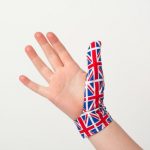
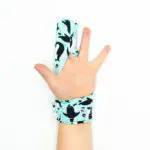
I prefer approaches that are simple, comfortable and easy for families to use. Taping popsicle sticks to the fingers can be helpful for some children. Mavela Stop is another option that many families have found useful. I also like the Thumbsie, because it gives children some ownership and involvement in the process, which helps create motivation.
Supporting Healthy Smile Development
Every child is different, and stopping finger habits may take patience, encouragement and finding the strategy that works best for your family. The goal isn’t just stopping the habit; it‘s supporting healthy jaw development and creating the best environment for a child’s smile to grow.
The longer a habit continues, the more likely it is that dental changes may develop and the more challenging they become to correct. If you’re concerned about your child’s habit, bite, or smile development, an orthodontic evaluation helps you better understand what‘s happening.
Thumb Sucking Solutions: Request Your Complimentary Consultation
If your child has finger habits such as thumb sucking, or you have questions about how a habit may be affecting their smile, we invite you to request a complimentary consultation. As an orthodontist, I can help evaluate your child’s bite, jaw growth and tooth development while helping you understand whether orthodontic care may be recommended.
At Joosse Family Orthodontics in Williamsburg, VA, we believe early guidance, personalized care and open communication helps families make confident decisions about their child’s orthodontic future. Whether you are concerned about finger habits or simply want to learn more about your child’s smile development, my team and I are here to help.
Please note all comments will need to be approved before appearing on this page. Please respect others when posting.



















Comments